

Introduction
Ask where Mertapada Wetan is, and the answer is simple: a village in Astanajapura District, Cirebon Regency. But a village is more than its coordinates. Its identity is also found in the stories passed down, the figures remembered, and the customs that mark a person's life from before birth to marriage. Mertapada Wetan is one such place.
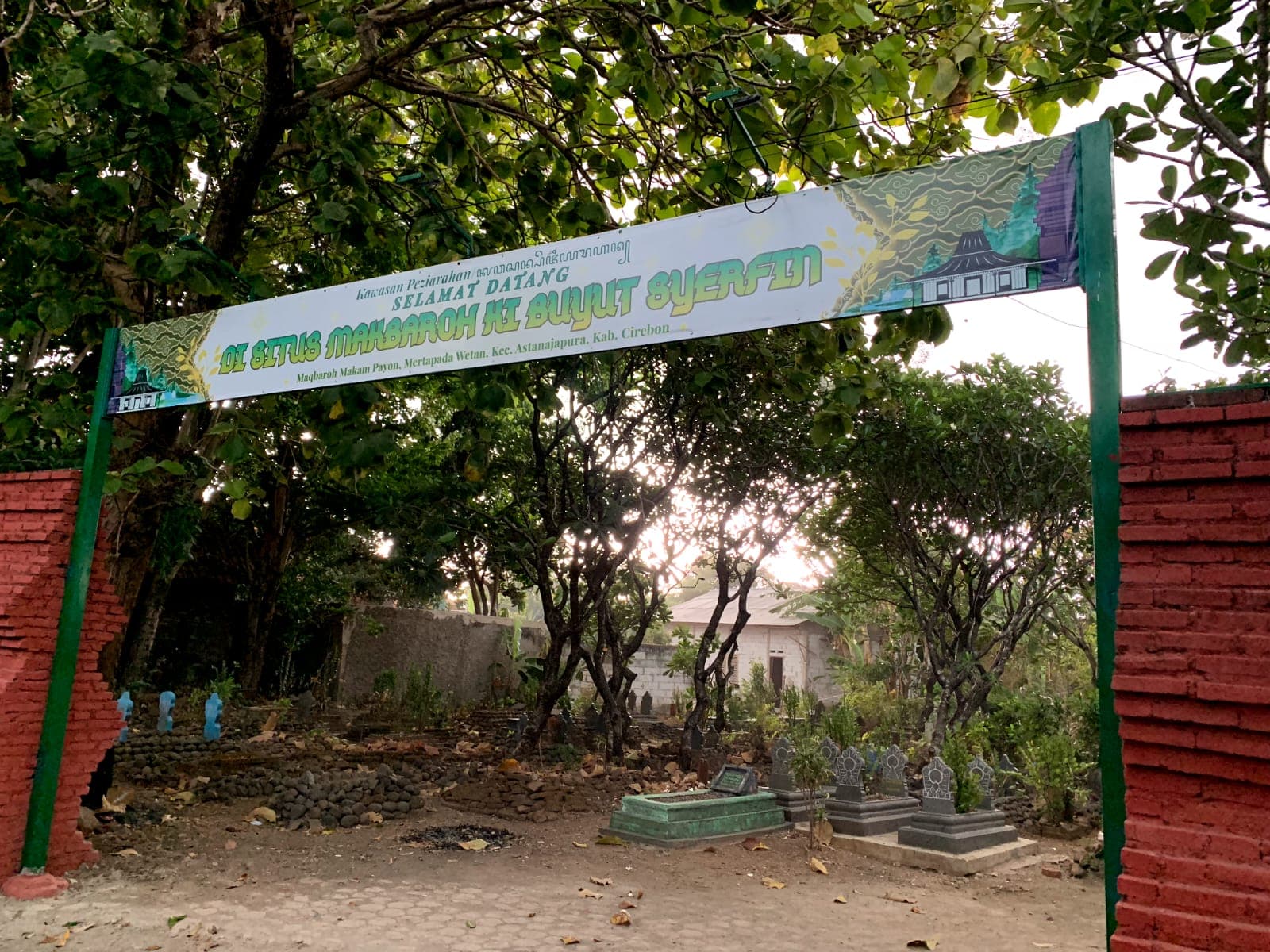
On Friday, October 30, 2026, a field observation was conducted in the village to learn about its history, traditions, and daily life. The observation included an interview with Bapak Hendra, a traditional elder of Mertapada Wetan, as well as documentation around the tomb complex of Ki Buyut Syerfin. The findings show a village with deep historical roots, living religious traditions, and economic dynamics that deserve closer attention.
From Mertalaya to Mertapada
According to the sources gathered, this area was once known as Mertalaya. The name is interpreted as a place that is pleasant, safe, and prosperous: merta means place, and laya means pleasant, safe, and prosperous.
The figure associated with the founding of the village is Syekh Arifin, a religious scholar from Baghdad. Nizar (2025) records that the village began to take shape in 1479 CE through him, and local residents know him as Ki Buyut Syerfin. A thesis from UIN Siber Syekh Nurjati Cirebon adds that after his passing, leadership was continued by Kyai Raden Ampunantara and then Nyai Mursifah, who later divided the area into Mertapada Kulon (west) and Mertapada Wetan (east).
According to Bapak Hendra, the area was originally a small and fairly old kingdom, believed to have been called Mertalaya. Over time it split into several separate areas, including Mertapada Kulon, Mertapada Wetan, and Kendal. This fits the written sources above, which also describe Mertalaya as the older name of the settlement.
Village Profile
Mertapada Wetan is located in Astanajapura District, Cirebon Regency, West Java. BPS data for 2024, cited by Nizar (2025), records an area of about 2.14 square kilometers and a population of 8,185. With this size and population, the village is fairly dense and lively.
The village is known for being religious. Its closeness to the Buntet Islamic Boarding School and the presence of several other pesantren nearby help shape the religious atmosphere of everyday life.
Economic Mobility and Location
Mertapada is one of the intermediary areas between the city of Cirebon and eastern Cirebon. This position fits the village's trade-based economy, since the main road that carries people through the area is also where the market sits.
Road Access and Connectivity
The main road is easy to access. The smaller roads inside the village are more uneven. By the author's estimate during the field observation, about 55 percent of them are in good condition and about 45 percent are damaged or full of potholes. Some stretches have already been repaired and are now in good shape.
Haul Ki Buyut Syerfin: A Tradition That Keeps Memory Alive
The most prominent cultural tradition in the village is the Haul Ki Buyut Syerfin. A haul is an annual commemoration of the death of someone regarded as having rendered great service, especially a religious scholar or leader. The activities usually include pilgrimage, tahlil, communal prayer, religious study sessions, and social activities.
According to local accounts, Ki Buyut Syerfin was a religious figure who came and settled in the area of Mertalaya and is believed to have played a role in the development of the community's religious life. His tomb is still well kept and regularly visited, and a haul is held every year to honor his contributions (Nizar, 2025).
The tradition has several purposes: to pray for him, to remember his service and example, to introduce the history of a local figure to younger generations, to strengthen community bonds, and to keep local culture alive. Its benefits are broad. Socially, it strengthens relationships and mutual cooperation (gotong royong). Religiously, it is a space for prayer and religious learning. Culturally, it protects local history and tradition from being lost. For the wider community, it opens room for activities such as support for orphans.
Then and Now
centered on pilgrimage, prayer, and religious study. Today the program is more varied. The 2026 haul included tahlil, religious study sessions, pilgrimage, hadroh (Islamic percussion music), a carnival, children's competitions, support for orphans, and other social activities. This shows that the tradition is maintained while its form adapts to the needs of present-day society.
Beyond a Single Tradition: Customs That Mark a Life
The haul is only one thread in the village's cultural life. As elsewhere in Cirebon, many customs accompany a person from pregnancy through birth, childhood, and marriage. Studies of Cirebon's life-cycle rituals describe exactly this sequence (Busro).
Nuju Bulan (Tebus Weteng)
Nuju Bulan, also called Tebus Weteng or Memitu, is a thanksgiving held when a pregnancy reaches its seventh month, usually at the home of the expectant mother's parents or at the couple's own home. Nizar (2025) documented the tradition in Mertapada Wetan and describes this sequence:
- Preparation. The host family invites close relatives and divides the tasks: handing out invitations, preparing food, and, for the men and youth, building a simple bamboo hut for the bathing ceremony.
- Qur'an recitation. Family members read selected chapters, commonly the "surat tujuh" (Yasin, Waqi'ah, Al-Mulk, Al-Kahfi, Luqman, Yusuf, and Maryam), as a prayer for the safety of mother and baby. Yasin read three times can replace them, and other informants named different chapters, so practice varies from family to family.
- Maulid reading. Women of the religious study group recite the Prophet's birth story (marhabanan), as a prayer for blessings and good character for the child. Bathing with flower water. The mother and her husband enter the bamboo hut and are bathed with flower water that has been prayed over, as a way of seeking blessing from the elders.
- The coconut. The mother sits with a coconut on her lap and then stands so that it falls to the ground, symbolizing an easy birth.
- Closing prayer. A religious leader leads the final prayers, including Surah Al-Qadr and Ayat Kursi.
- Shared meal. Guests eat the food prepared by the family. This joins the Islamic value of charity with the local custom of sharing food after an event.
Bubur Merah Putih
Red and white porridge appears at many Javanese thanksgiving meals, especially for births and naming ceremonies. It is commonly read as a prayer for the child and as protection from misfortune, and its two colors are often explained as representing the mother's and father's roles in a child's origin. In West Java the two porridges are usually served side by side (Good News From Indonesia, 2025).
Mudun Lemah
Mudun means to go down and lemah means ground, so Mudun Lemah is the "first steps on the ground" ceremony for a baby. Accounts from Cirebon place it when the child is about seven months old by the Javanese calendar. It expresses gratitude for a healthy child, respect for the earth the child touches for the first time, and a wish to ward off misfortune (Busro; Meilasari et al., 2024).
A study in nearby Kanci Village, in the same Astanajapura District, describes the procession in three parts (Meilasari et al., 2024): The toy becak. The parents make a small becak (pedicab) from bamboo, decorate it with colored paper, and attach a ladder. Colored flags with money pinned to them, and small gifts, are placed on its four sides. The becak symbolizes the "descent" to the ground.
The seven plates. Guided by a traditional baby attendant (dukun bayi), the child climbs down the ladder and steps in turn on seven plates holding soil, goat droppings, unhusked rice, rice bran, red porridge, white porridge, and sweet glutinous-rice-ball porridge (bubur candil). The whole sequence is repeated three times. Curak. Afterward the parents scatter money among onlookers, who scramble to collect it. Today some families scatter instant noodles or other packaged food instead.
Each plate carries a meaning. Soil marks the first contact with the earth, rice stands for prosperity, and the animal droppings express a wish that the child will be close to livestock and animals. Bubur candil stands for firmness of heart, red porridge for courage, white porridge for purity, and rice bran for fertility. The same study notes that the materials have changed over time, for example plastic plates giving way to glass or aluminum bowls, according to each family's preference. Neighboring villages often follow comparable forms, though details can differ from family to family.
Sawer (Curak)
Sawer, or saweran, is best known as part of Sundanese wedding custom, where a sawer leader scatters items such as rice, turmeric, and coins while singing advice to the couple (Mediator, 2006). In Mertapada Wetan, as learned during the field observation, the custom takes a broader form: a person scatters money to a gathered crowd as a way of sharing their fortune. It usually follows something to be thankful for, such as buying a house or a new motorbike, getting married, or a child taking their first steps. It is close to surak, the scattering of money that ends the Mudun Lemah ceremony in nearby Kanci (Meilasari et al., 2024).
Together, these customs show how religious practice and local tradition sit side by side in daily life. They are the reason Mertapada Wetan is more than a place on the map.
Meaning and Opportunities for Preservation
The Haul Ki Buyut Syerfin is not only a religious event but also part of the cultural identity of Mertapada Wetan. It carries values of religiosity, respect for earlier figures, mutual cooperation, togetherness, and the preservation of local history. Its continuation is one way the community keeps the past connected to life today.
Preservation will be stronger when many parties take part, especially young people, religious leaders, traditional elders, and the village government. Documenting the village's history and the haul can also help introduce this local figure to the next generation.
Conclusion
Mertapada Wetan is more than a place on the map. Its history begins with Mertalaya and Syekh Arifin, or Ki Buyut Syerfin. Its calendar is marked by the annual haul. Its everyday life is shaped by customs that accompany people from pregnancy to marriage, such as Nuju Bulan, Mudun Lemah, and Sawer. At the same time, residents' livelihoods and access to the village are an important part of how the village looks today.
Trade and a well-connected main road give the village its economic strength, while the damaged inner roads remain the clearest area for improvement.
Interview with Bapak Hendra, Traditional Elder of Mertapada Wetan