

Village Introduction
Welcome to East Cirebon, where lush hills, terraced rice fields, and thriving fruit orchards meet a cultural borderland shaped by Cirebon’s Javanese roots and Sundanese traditions. Set in Lemahabang District roughly 25 kilometers from Cirebon’s city center, Desa Belawa stretches across a quiet landscape where rare freshwater wildlife, living folklore, and deep prehistory quietly converge.

What makes Desa Belawa truly remarkable is the contrast between its two defining cultural landmarks: the sacred Cikuya spring sanctuary, home to the rare Belawa softshell turtle (Amyda cartilaginea) and the fading prehistoric Peti Kubur Batu site dating back thousands of years before the Cirebon Sultanate. Alongside these heritage sites, Belawa also thrives as an agricultural powerhouse. According to Abah Danda, a longtime local mango farmer, the village stands as the premier mango supplier in Cirebon Regency, spanning over 200 hectares of fertile trees and accounting for roughly 20 percent of the regency’s total harvest. Local farmers cultivate prized varieties such as Harumanis and Gedong Gincu, supplying surrounding markets across Cirebon Regency before sending harvests to major markets in Jakarta and Palembang, while limited export shipments to Asia and the Middle East remain in development.

Beyond its orchards, Belawa holds a quieter role as a living archive where water ecology, local folklore, and deep prehistory intersect, revealing how rural West Java balances modern agricultural trade with fragile cultural memory across generations.
The Cikuya Sanctuary and the Rarity of Belawa’s Softshell Turtle
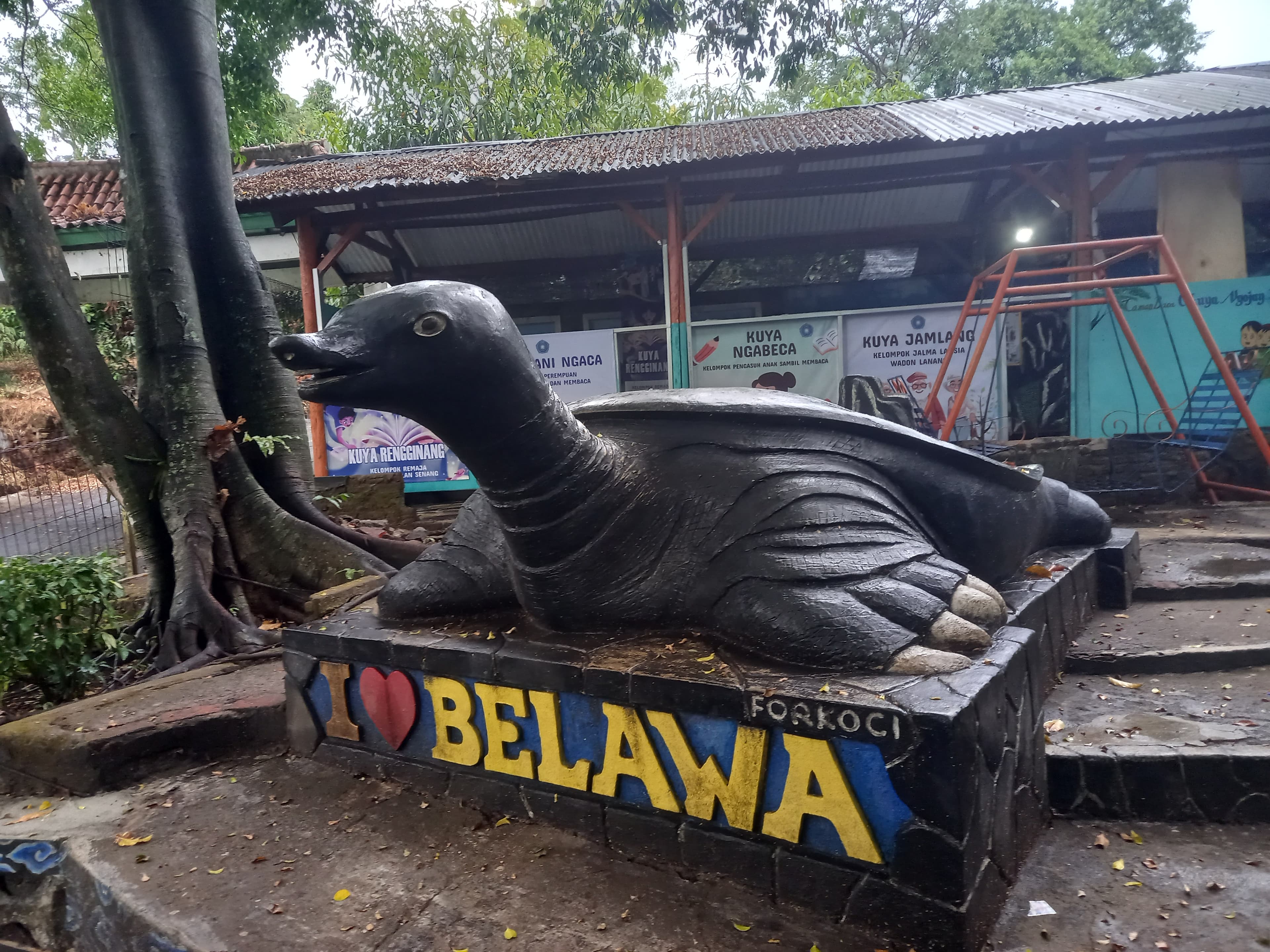
At the center of Belawa’s ecotourism appeal is the Cikuya conservation pond complex, a spring sanctuary spanning roughly 630 square meters. Framed by natural stone walls and protective bamboo fencing, the pool sits beneath mature shade trees that keep the water cool and undisturbed. Walking through the site during the field observation on October 29, 2026, revealed how Cikuya works as both an ecological refuge and an open classroom. Tiered stone and concrete walkways frame the main water basin, an educational display area exhibits preserved turtle carapaces so visiting students can examine their anatomy up close, and a sculpted tortoise monument greets visitors at the entrance. Along the outer perimeter, small food stalls and shaded seating support local entrepreneurs during weekend visits and school outing trips, linking conservation directly to everyday village livelihoods.
The sanctuary’s centerpiece is the endemic Belawa softshell turtle (Amyda cartilaginea, locally known as Kuya Belawa or labi labi Belawa). Unlike familiar turtles with rigid shells, Amyda cartilaginea has a dark, leathery, flexible carapace marked by distinct longitudinal ridges along its back, paired with a pointed, tubular snout built for breathing while submerged in muddy riverbeds and spring pools. Watching these turtles surface slowly in the clear spring water or rest along damp stone ledges offers visitors an intimate encounter with a species rarely seen in the wild.

The biological rarity of Amyda cartilaginea is what gives Cikuya such extraordinary conservation value. Across much of Southeast Asia, wild softshell turtle populations have declined sharply due to habitat loss, water pollution, and overharvesting, making protected, stable colonies increasingly scarce. Insights from our interview with Abah Kusna, a community elder and former conservation caretaker at Cikuya, indicate that although the species remains vulnerable, the current conservation situation has improved compared to the earlier period when he managed the care largely on his own. In Belawa today, ongoing efforts to strengthen Pokdarwis (tourism awareness group) management, maintain spring water cleanliness, and improve visitor education aim to help Cikuya remain both a safe haven for a vulnerable species and a cornerstone for sustainable cultural tourism.
Sacred Lore, Customary Values, and Generational Language Change
Local folklore weaves spiritual meaning directly into the Cikuya spring and its resident tortoises. Village tradition traces their origin to the story of Jaka Saliwah, a young man born with two toned skin who sought healing from the Islamic scholar Syekh Datuk Putih, and to torn pages of sacred manuscripts cast into the spring that transformed into the first tortoises, whose ridged backs resemble the folds of a book. Visitors can also read this narrative directly on informational panels displayed at the Cikuya site. Over generations, the legend has inspired the local KUYA philosophy, short for Kudu Yakin, which encourages unwavering faith and patience, while reinforcing a strict customary taboo known as pamali. Abah Kusna noted that customary pamali provides near total protection for the endemic turtles by prohibiting residents and visitors from harming, eating, or removing them from the village.
At the same time, daily life in Belawa reflects quiet generational changes. Among younger residents, there is a noticeable language shift from Sundanese toward Indonesian, illustrating how modern education, digital media, and broader mobility gradually reshape everyday speech in a borderland village.
The Fading Memory of Peti Kubur Batu
Beneath these familiar legends lies an even older, prehistoric chapter of Belawa’s past whose everyday visibility is gradually fading: the megalithic Peti Kubur Batu (stone grave) site. Long before the Cirebon Sultanate was founded, Belawa’s earliest inhabitants practiced animism and dynamism, revering ancient trees and sacred stones, and used stone chests or sarcophagi from ancient times, not necessarily massive in scale yet dating back roughly 5,000 years or more, to bury respected ancestors and community leaders. Set across a wide, open tract beside a ravine overlooking Mount Ciremai, the site offers a striking glimpse into prehistoric Cirebon when the surrounding hills were still dense and untouched.

Today, however, physical neglect mirrors that gradually fading. The area around the stone graves now sits close to trash waste, making the site difficult to access and visit because it receives little upkeep or public attention. Conversations with local sources show just how unevenly this prehistoric heritage is remembered across generations. Even lifelong residents across the community remain unaware of the stone graves, whereas older family elders, such as the author's own grandfather, still recall the site’s ancient origins and significance. That contrast highlights both the depth of Belawa’s early history and how easily ancient heritage can become physically inaccessible and less familiar when elders and younger generations stop sharing those stories.
Cultural Significance
Desa Belawa’s landscape matters to Cirebon’s broader cultural identity because it proves that human settlement here reaches far back into the prehistoric, animist and dynamist era long before the rise of the Cirebon Sultanate. The sacred shells of Amyda cartilaginea at Cikuya, paired with customary pamali, show how local belief systems can protect fragile ecosystems while binding a community together. Meanwhile, the neglected Peti Kubur Batu site and the gradual shift from Sundanese to Indonesian serve as a stark reminder that without active care and living memory, both ancient landmarks and local languages risk slipping quietly out of everyday life.
Desa Belawa stands out as a village shaped by living contrasts, where a protected Amyda cartilaginea sanctuary, thriving mango orchards, shifting youth language habits, and the prehistoric Peti Kubur Batu site all exist side by side. Preserving this heritage calls for practical care around overlooked historic grounds and steady dialogue between elders and younger generations, ensuring that Belawa’s ecological and prehistoric stories remain alive in Cirebon.